

Ear Tube Surgery
What Is Ear Tube Surgery?
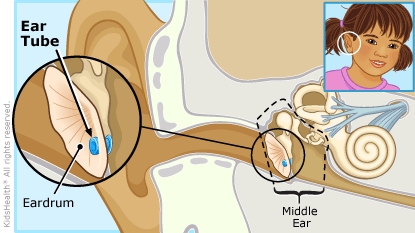
Ear tubes are tiny tubes made of metal or plastic. During ear tube surgery, a small hole is made in the eardrums and the tubes are inserted. The opening to the middle ear (the area behind the eardrum) lets air flow in and out. This keeps air pressure even between the middle ear and the outside, and helps to drain fluid that builds up behind the eardrum.
Most kids won't need surgery to have a tube taken out later. Ear tubes usually fall out on their own, pushed out as the eardrum heals.
Ear tubes are also called tympanostomy tubes, myringotomy tubes, ventilation tubes, or pressure equalization (PE) tubes.
Why Is Ear Tube Surgery Done?
Many kids get middle ear infections (otitis media). This often happens when a child has a cold or other respiratory infection. Bacteria or viruses can enter the middle ear and fill it with fluid or pus. When fluid pushes on the eardrum, it can cause an earache and affect hearing. Long periods of decreased hearing in young children can lead to delays in speech development.
Children who get a lot of ear infections are sometimes sent for hearing tests.
A doctor might suggest ear tube surgery if:
- a child gets many ear infections that don't clear up easily
- the ear infections seem to be causing hearing loss or speech delay
Ear tube surgery can drain fluid from the middle ear, prevent future infections, and help the child hear properly again.
What Happens Before Ear Tube Surgery?
Your health care provider will tell you what and when your child can eat and drink before the surgery, because the stomach must be empty on the day of the procedure.
Surgery, no matter how common or simple, can be scary for kids. You can help prepare your child by talking about what to expect during the ear tube surgery.
-
30-Second Summary: Ear Tube Surgery
Learn the basics in 30 seconds.
What Happens During Ear Tube Surgery?
An ear, nose, and throat (ENT) surgeon will do the surgery, called a myringotomy (meer-in-GOT-uh-mee). It's done in an operating room while your child is under general anesthesia. The anesthesiologist will carefully watch your child and keep him or her safely and comfortably asleep during the procedure.
The surgeon will make a small hole in each eardrum and remove fluid from the middle ear using suction. Because the surgeon can reach the eardrum through the ear canal, there are no visible cuts or stitches.
The surgeon will finish by putting the small metal or plastic tube into the hole in the eardrum.
How Long Does Ear Tube Surgery Take?
Ear tube surgery usually takes about 10 to 15 minutes.
What Happens After Ear Tube Surgery?
Your child will wake up in the recovery area. In most cases, the total time spent in the hospital is a few hours. Very young children or those with other medical problems may stay longer.
Your child may vomit a little on the day of the surgery or have a minor earache. Some children's ears will pop when they burp, yawn, or chew. This should go away as the eardrum heals.
Ear tubes help prevent ear infections by allowing air into the middle ear. Other substances, such as water, may sometimes enter through the tube, but this is rarely a problem. Your surgeon might recommend earplugs for bathing or swimming.
It's OK for your child to travel in airplanes after having ear tubes placed. The ear tubes will help even out air pressure inside and outside the ear.
Ear tubes won't prevent all ear infections, but they can make them milder and happen less often. In some cases, the tubes might need to be put in again.
In most cases, surgery to remove an ear tube isn't necessary. The tube usually falls out on its own, pushed out as the eardrum heals. A tube generally stays in the ear anywhere from 6 months to 18 months, depending on the type of tube used.
If the tube stays in the eardrum beyond 2 to 3 years, though, your doctor might choose to remove it surgically.
Are There Any Risks From Ear Tube Surgery?
This is a very common and safe procedure, although there are risks with any surgery, including infection, bleeding, and problems with anesthesia.
Rarely, the hole in the eardrum does not close after the tube comes out, and might need to be fixed surgically.
How Can Parents Help After Ear Tube Surgery?
- If your child's doctor prescribed pain medicine and/or ear drops to use after the surgery, give them as directed.
- Your child can return to a regular diet at home, and can return to normal activities after a day of rest.
- You might see a small amount of fluid draining from the ears for a couple of days. You can place a clean cotton ball in the opening of each ear to catch the drainage, but don't stick cotton swabs in the ears.
- Your child should avoid blowing his or her nose too hard.
When Should I Call the Doctor?
Call the doctor if:
- Your child can't keep any fluids down or keeps vomiting.
- Your child develops a fever.
- Your child has new ear pain or pain that doesn't go away with medicine.
- The prescribed ear drops cause discomfort.
- One or both of your child's ears drain for more than 7 days after surgery.
- Your child has yellowish-green ear drainage, or has a bad smell coming from the ear.
- An ear tube falls out in the first few weeks.
See the doctor right away or go the emergency room if there is a lot of blood in the ear drainage or if the ear pain is severe.