

Nose
What Does the Nose Do?
The nose lets you smell and it's a big part of why you are able to taste things. The nose is also the main gate to the respiratory system, the body's system for breathing.
Watch & Learn Together!
Kids love our Chloe and Nurb videos about how the body works! Learn all about the nose and what it does.
-

Nose
It sniffs and smells, but how does it work? Find out more in this nose video.
Test Your Knowledge!
After watching, take this quiz to test your knowledge of the nose.
What Are the Parts of the Nose?
The nose has two holes called nostrils. The nostrils and the nasal passages are separated by a wall called the septum (SEP-tum). Deep inside the nose, close to the skull, the septum is made of very thin pieces of bone.
Closer to the tip of the nose, the septum is made of cartilage (KAR-tel-ij), which is flexible material that's firmer than skin or muscle. It's not as hard as bone, and if you push on the tip of your nose, you can feel how wiggly it is.
Behind the nose, in the middle of the face, is a space called the nasal cavity. It connects with the back of the throat. The nasal cavity is separated from the inside of the mouth by the palate (roof of the mouth).
How Does the Nose Help With Breathing?
When you inhale air through your nostrils, the air enters the nasal passages and travels into the nasal cavity. The air then passes down the back of the throat into the trachea (TRAY-kee-uh), or windpipe, on its way to the lungs.
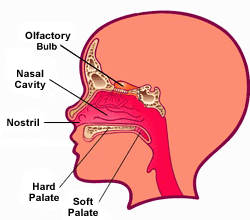
The nose is also a two-way street. When you exhale old air from your lungs, the nose is the main way for the air to leave your body. But your nose is more than a passageway for air. The nose also warms, moistens, and filters the air before it goes to the lungs.
What's the Mucous Membrane?
The inside of the nose is lined with a moist, thin layer of tissue called a mucous membrane (MYOO-kus MEM-brayne). This membrane warms up the air and moistens it. The mucous membrane makes mucus, that sticky stuff in the nose that some people call snot. Mucus captures dust, germs, and other small particles that could irritate the lungs. If you look inside your nose, you will also see hairs that can trap large particles, like dirt or pollen.
If something does get trapped in there, you sneeze. Sneezes can send those unwelcome particles speeding out of the nose at 100 mph.
Further back in the nose are even smaller hairs called cilia ( SILL-ee-uh) that you can see only with a microscope. The cilia move back and forth to move the mucus out of the sinuses and back of the nose. Cilia can also be found lining the air passages, where they help move mucus out of the lungs.
How Does Smelling Work?
The nose allows you to make scents of what's going on in the world around you. Just as your eyes give you information by seeing and your ears help you out by hearing, the nose lets you figure out what's happening by smelling. It does this with help from many parts hidden deep inside the nasal cavity and head.
Up on the roof of the nasal cavity (the space behind the nose) is the olfactory epithelium ( ol-FAK-tuh-ree eh-puh-THEE-lee-um). Olfactory is a fancy word that has to do with smelling. The olfactory epithelium contains special receptors that are sensitive to odor molecules that travel through the air.
These receptors are very small — there are about 10 million of them in the nose. There are hundreds of different odor receptors, each with the ability to sense certain odor molecules. Research has shown that an odor can stimulate several different kinds of receptors. The brain interprets the combination of receptors to recognize any one of about 10,000 different smells.
How Does the Brain Recognize Smells?
When the smell receptors are stimulated, signals travel along the olfactory nerve to the olfactory bulb. The olfactory bulb is underneath the front of the brain just above the nasal cavity. Signals are sent from the olfactory bulb to other parts of the brain to be interpreted as a smell you may recognize, like apple pie fresh from the oven.
Identifying smells is the brain's way of telling you about your environment. Have you ever smelled your toast burning? In an instant, your brain interpreted the smell and a problem, and you knew to check on your toast.
You learned to associate a certain smell with burning and now your brain remembers that smell so you recognize it. Your sense of smell also can help you keep safe. For example, it can warn you not to eat something that smells rotten or help you detect smoke before you see a fire.
How Does the Nose Help With Taste?
Most people just think of the tongue when they think about taste. But you couldn't taste anything without some help from the nose. The ability to smell and taste go together because odors from foods allow us to taste more fully.
Take a bite of food and think about how it tastes. Then pinch your nose and take another bite. Notice the difference? It's just another reason to appreciate your nose.