
Pregnancy at 7 Weeks: Weekly Calendar

Your Baby's Development at 7 Weeks
What Are My Baby’s Weight & Size at 7 Weeks?
Your baby is working hard to grow and develop! When you are 7 weeks pregnant , your baby weighs about 0.33 of an ounce and is about the size of a blueberry.

Development Milestones at 7 Weeks
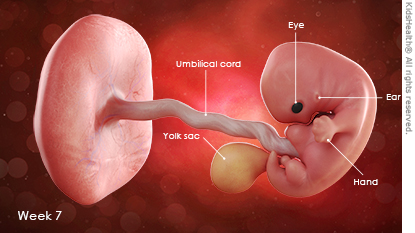
The umbilical cord has formed. It’s your baby's direct connection to you — providing oxygen, nourishment, and disposing waste. Your baby's digestive tract and lungs continue to form.
That beautiful baby face is taking shape . The mouth, nostrils, ears, and eyes are some of the facial features that will become more defined this week.
Your baby's arm bud that developed last week has a hand on the end of it, which looks like a tiny paddle.
Your Body When You’re 7 Weeks Pregnant
Pregnancy Symptoms at 7 Weeks
Pregnancy causes many changes to your cervix. By this week you'll have developed a mucus plug, which forms in the opening of the cervical canal and seals off the uterus to protect it from infection. (You'll lose this plug later when your cervix dilates to get ready for labor.)

Around this time, you’ll develop pregnancy signs that you can actually see and feel. This may include:
- sore or tender breasts
- nausea or morning sickness (which can happen any time of day)
- frequent urination (peeing a lot)
- cramps that feel like period pain
- increased saliva production in your mouth
Discuss how to best manage your symptoms, and any other concerns, with your health care provider.
Important Appointments
Good prenatal care is crucial for your health and your baby’s health. Once you’ve confirmed your pregnancy on a home pregnancy test or blood or urine test at the doctor's office, schedule your first prenatal visit.
If your pregnancy is considered high-risk (for example, if you are older than 35 or have a history of pregnancy complications), your doctor may want to see you as early as possible and more often during pregnancy.
First Prenatal Visit
At your first prenatal visit, the doctor or nurse practitioner will confirm that you’re pregnant and estimate your due date (when your baby might be born). This date is based on when you had your last period. Sometimes a prenatal ultrasound (a test that uses sound waves to make a picture of your baby) can help figure out the due date.
The doctor will do a physical exam to check your health and may want to doprenatal tests. Prenatal tests check your health and your baby’s health. Some are screening tests that can only show the chance of a problem. Others are diagnostic tests that can find out if your baby has a certain problem.
At your first appointment, the doctor also will:
- discuss your health history
- discuss prenatal vitamins, lifestyle, and nutrition recommendations
- establish a prenatal care plan
- address questions and concerns
Common Blood Tests Around 7 Weeks
While you’re pregnant, prenatal lab work — like blood tests — is offered during the first trimester (weeks 1–12), second trimester (weeks 13–27), and third trimester (weeks 28–40).
Your provider will probably send you for a blood test to find out whether you're immunized against varicella (chickenpox) and rubella (German measles), and to find out your blood type and Rh factor. You also may be tested for certain infections, such as syphilis or hepatitis B, and you may be offered an HIV test.
Bloods tests for certain genetic disorders also may be given. The type of tests offered will depend on your situation and preference.
 Note: All information is for educational purposes only. For specific medical advice,
diagnoses, and treatment, consult your doctor.
Note: All information is for educational purposes only. For specific medical advice,
diagnoses, and treatment, consult your doctor.
© 1995- The Nemours Foundation. KidsHealth® is a registered trademark of The Nemours Foundation. All rights reserved.
Images sourced by The Nemours Foundation and Getty Images.