
In this section
Make an Appointment
Make an appointment
To make an appointment: call the Central Scheduling or use the "request an appointment" button to submit your request online.
(877) 607-5280Pregnancy at 5 Weeks: Weekly Calendar

Your Baby's Development at 5 Weeks
What Are My Baby’s Weight & Size at 5 Weeks?
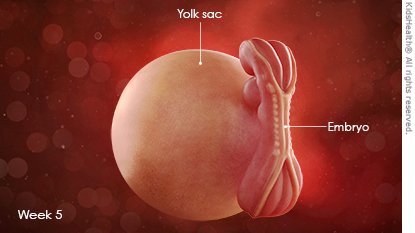
When you are 5 weeks pregnant, your baby is about the size of a sesame seed and weighs very little.
Lots of important changes happen this week, as the embryo changes from two layers into three layers (the ectoderm, the mesoderm, and the endoderm). These three layers will form your baby’s skin, nervous system, cardiovascular system, and digestive and respiratory tracts.

Development Milestones at 5 Weeks
Until now, your embryo has been a mass of cells. But soon a shape will take form.
The neural tube (which will become the spinal cord and brain) runs from the top to the bottom of your baby. A bulge in the center of the embryo will develop into your baby's heart, as the heart and circulatory system begin to develop.
At this time , the placenta develops. The placenta has finger-like projections, called chorionic villi, that supply nourishment from you to your baby.
Your Body When You're 5 Weeks Pregnant
Pregnancy Symptoms at 5 Weeks
Most women won’t feel many signs of pregnancy this early. But for others, symptoms like breast tenderness, bloating, mood swings, and fatigue can start this week especially since the pregnancy hormone hCG is now detectable.
You may have slight cramping and spotting. Some people mistake this for a period, especially because this is around the time their monthly period is due.
If you have not yet taken an at-home pregnancy test, this week the test could probably detect your pregnancy. The same hCG hormone that brings on pregnancy symptoms also makes it possible for a test to confirm your pregnancy.
Important Appointments to Schedule
Good prenatal care is crucial for your health and your baby’s health. This medical care is provided before and during pregnancy, childbirth, and right after your baby is born. If you haven’t already, schedule your first prenatal visit, which usually happens by the end of the first trimester.
If your pregnancy is considered high-risk (for example, if you are older than age 35 or have a history of pregnancy complications), your doctor may want to see you as early as possible, and more often, during your pregnancy.
If you do not have an obstetrician (a doctor who cares for you during pregnancy), this is a good time to find one. Ask your primary care doctor for names of doctors, and you can ask friends and family who have recently given birth for their suggestions.
What Can I Expect at My First Prenatal Visit?
At your first prenatal visit, the doctor or nurse practitioner will confirm that you’re pregnant and estimate your due date (when your baby might be born). This date is based on when you had your last period. Sometimes a prenatal ultrasound (a test that uses sound waves to make a picture of your baby) can help figure out the due date.
The doctor will do a physical exam to check your health and may want to do prenatal tests. Prenatal tests check your health and your baby’s health. Some are screening tests that can only show the chance of having a problem. Others are diagnostic tests that can find out if your baby has a certain problem.
At your first appointment, the doctor also will:
- discuss your health history
- discuss prenatal vitamins, lifestyle, and nutrition recommendations
- establish a prenatal care plan
- address questions and concerns
Tips for this week
Even if nausea hasn't hit you yet, you'll want to steer clear of some foods. Foodborne illnesses, such as listeriosis and toxoplasmosis, may cause birth defects or even miscarriage.
Foods to Avoid
Here are some foods to avoid:
- soft, unpasteurized cheeses (often advertised as "fresh") such as feta, goat, Brie, Camembert, and blue cheese
- unpasteurized milk, juices, and apple cider
- raw eggs or foods containing raw eggs, including mousse and tiramisu
- raw or undercooked meats, fish, or shellfish
- processed meats such as hot dogs and deli meats (if you eat them, they should be well-cooked)
- fish high in mercury, including shark, swordfish, king mackerel, or tilefish
Toxoplasmosis also can spread from soiled cat litter boxes, so have someone else clean the litter box during your pregnancy.
 Note: All information is for educational purposes only. For specific medical advice,
diagnoses, and treatment, consult your doctor.
Note: All information is for educational purposes only. For specific medical advice,
diagnoses, and treatment, consult your doctor.
© 1995- The Nemours Foundation. KidsHealth® is a registered trademark of The Nemours Foundation. All rights reserved.
Images sourced by The Nemours Foundation and Getty Images.