All About Periods

Overview
What Is a Period?
A period, sometimes called menstruation (pronounced: men-STROO-ay-shun), is a release of blood from a female’s uterus, out through the vagina. It’s a sign that the end of puberty is coming. It also means that she can get pregnant if she has sex.
There’s a lot to learn about periods. Here are answers to some common questions.
When Do Periods Usually Start?
Most females get their first period when they're around 12. But sometimes it comes a few years earlier or later. Everyone’s body has its own schedule.
There isn't one right age to get a period. But signs to watch for include:
- breasts starting to develop (periods usually start about two years after this)
- hair growing under a female's arms and in her private parts
- seeing or feeling vaginal discharge fluid (sort of like mucus), which usually begins about six months to a year before a girl gets her first period
Causes
What Causes a Period?
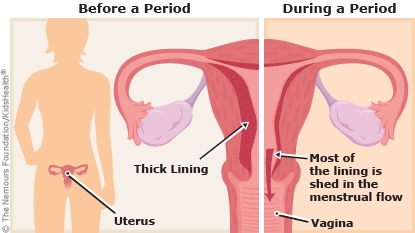
A period happens because of changes in hormones in the body. Hormones are chemical messengers. The ovaries release the female hormones estrogen and progesterone, which cause the lining of the uterus (or womb) to build up. The built-up lining is ready for a fertilized egg (an egg that has joined with a sperm) to attach to and develop into a baby. If there’s no fertilized egg, the lining breaks down and bleeds. Then the same process happens all over again.
It usually takes about a month for the lining to build up, then break down. That is why most people get their periods around once a month.
Ovulation & Pregnancy
How Does Ovulation Relate to Periods?
Ovulation (pronounced: ov-yoo-LAY-shun) is the release of an egg from the ovaries. The same hormones that cause the uterus lining to build up also cause an egg to leave one of the ovaries. The egg travels through a thin tube called the fallopian tube to the uterus.
If the egg is fertilized by a sperm cell, it attaches to the wall of the uterus, where over time it develops into a baby. If the egg isn’t fertilized, the uterus lining breaks down and bleeds, causing a period.
Can You Get Pregnant on Your Period?
Yes, a female can get pregnant as soon as her period starts. It’s possible to even get pregnant right before the very first period because the hormones might already be active. The hormones may have led to ovulation and the building of the uterine wall. If this happens and the female has sex, she can get pregnant, even though she has never had a period.
Timing
Do Periods Happen Regularly When Menstruation Starts?
For the first few years after starting a period, it might be irregular (not come regularly). This is normal at first. By about 2–3 years after the first period, periods should be coming around once every 4–5 weeks. But some people get their periods a little less or more often.
How Long Do Periods Last?
Periods usually last about five days. But a period can be shorter or last longer.
Will I Have Periods for the Rest of My Life?
When women reach menopause (around age 45‒55), their periods will permanently stop. Periods also stop during pregnancy.
Flow & Period Products
How Much Blood Should I Expect?
It may look like a lot of blood, but most people usually lose only a few tablespoons of blood during the whole period. Sometimes you may have spotting (light bleeding). Other times, you may notice some clumps of blood during menstruation. But if you notice large or frequent clots, talk to your doctor.
It’s also normal for the color of period blood to be brown as well as red.
Which Period Products Should I Use?
You have many choices about how to handle period blood. You may need to experiment a bit to find which works best for you. Some people use only one method and others switch between different methods:
- Most people use pads when they first get their period. Pads are made of cotton and come in different sizes and shapes. They have sticky strips that attach to the underwear.
- Many people find tampons more convenient than pads, especially when playing sports or swimming. A tampon is a cotton plug that you put into your vagina. Most tampons come with an applicator that guides the tampon into place. The tampon absorbs the blood. Don't leave a tampon in for more than eight hours because this can increase your risk of a serious infection called toxic shock syndrome.
- Some people prefer a menstrual cup. Most are made of silicone. To use a menstrual cup, insert it into the vagina. It holds the blood until you empty it.
- Period underwear is underwear that absorbs blood like pads do, helping keep you dry and preventing leaks. When the flow is heavier, you can use it with tampons or a menstrual cup.
How Often Do I Change Them?
Most people need to change their pad, tampon, or menstrual cup about 3‒6 times a day. For period underwear, change it every 8‒12 hours or as needed, then rinse it with cold water and follow the label’s instructions for cleaning.
PMS & Cramps
What Is PMS?
PMS (premenstrual syndrome) is when emotional and physical symptoms happen before or during a period. These can include moodiness, sadness, anxiety, bloating, and acne. The symptoms go away after the first few days of a period.
What Helps With Period Cramps?
Many people have cramps with their period, especially in the first few days. This happens when the uterus squeezes. They are caused by a chemical in the body called prostaglandins (say: pross-tuh-GLAN-dinz). The squeezing of the muscles helps push the blood out through the vagina during a period.
If cramps bother you, you can try:
- a warm heating pad on your belly
- taking ibuprofen (Advil, Motrin, or a store brand) or naproxen (Aleve or a store brand)
When Should I Call the Doctor?
Most girls don't have any problems with their periods. But call your doctor if you:
- are 15 and haven't started your period
- have had your period for more than two years and it's still not regular (coming about every 4–5 weeks)
- have bleeding between periods
- have severe cramps that don't get better with ibuprofen or naproxen
- have very heavy bleeding (bleeding that goes through a pad or tampon in less than one hour)
- have periods that last more than about a week
- have severe PMS that gets in the way of your everyday activities
- have had sex and your period is late (you could be pregnant)
What Else Should I Know?
Choosing foods high in iron during menstruation helps replace iron lost through bleeding. Good choices include iron fortified cereal or bread, lean meat, eggs, beans, nuts, raisins, chard, tomato sauce, and even molasses.
Periods are a natural, healthy part of life. They shouldn't get in the way of exercising, having fun, and enjoying life. If you have other questions about periods, ask your doctor, a parent, health teacher, school nurse, or older sister.
The Menstrual Cycle
This video shows what happens during the menstrual cycle – and why.
 Note: All information is for educational purposes only. For specific medical advice,
diagnoses, and treatment, consult your doctor.
Note: All information is for educational purposes only. For specific medical advice,
diagnoses, and treatment, consult your doctor.
© 1995- The Nemours Foundation. KidsHealth® is a registered trademark of The Nemours Foundation. All rights reserved.
Images sourced by The Nemours Foundation and Getty Images.