Greenstick Fractures

What Is a Greenstick Fracture?
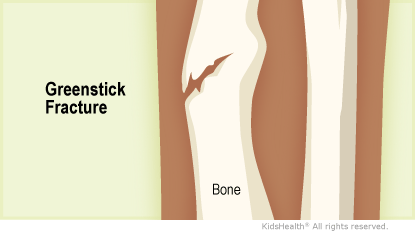
A greenstick fracture is a type of broken bone. A bone cracks on one side only, not all the way through the bone. It is called a "greenstick" fracture because it can look like a branch that has broken and splintered on one side.
Who Gets Greenstick Fractures?
Most greenstick fractures happen in kids younger than 10 years old because their bones are softer and more flexible than adult bones.
In teens and adults, the injury may cause the bone to break all the way through. But in kids, the bone breaks on one side only.
How Do Greenstick Fractures Happen?
Greenstick fractures usually happen when someone falls and reaches a hand out to break the fall.
What Are the Signs & Symptoms of a Greenstick Fracture?
Someone with a greenstick fracture will have signs of a broken bone like:
- pain
- swelling
- bruising
- deformity (the affected body part could look crooked or different after the injury)
How Is a Greenstick Fracture Diagnosed?
Doctors order X-rays if they think a bone is broken. In a greenstick fracture, the X-rays will show a crack in the broken bone that doesn’t go all the way through the bone.
How Are Greenstick Fractures Treated?
Usually, specialists treat this type of fracture with a cast.
If a fracture is very bent or curved, the doctor might first need to straighten it in a procedure called a reduction (or "setting the bone"). After giving medicine for pain and straightening the bone, the doctor might first place a splint or partial cast to allow room for the swelling. This is changed to a regular cast after a few days.
 Note: All information is for educational purposes only. For specific medical advice,
diagnoses, and treatment, consult your doctor.
Note: All information is for educational purposes only. For specific medical advice,
diagnoses, and treatment, consult your doctor.
© 1995- The Nemours Foundation. KidsHealth® is a registered trademark of The Nemours Foundation. All rights reserved.
Images sourced by The Nemours Foundation and Getty Images.
Humana Healthy Horizons in Ohio
- Humana Healthy Horizons
- Humana Healthy Horizons Extras
- Member Support
- Care management
- Caregiver resources
- Child well-being
- Disease management
- Documents and forms
- Enrollment
- Grievances and appeals
- Health and wellness
- KidsHealth
- Member Handbook
- New Member Resources
- News and alerts
- OhioRISE Plan
- Pregnancy outcomes
- Tobacco cessation
- Why Humana
- Your primary care provider
- For Providers
- Contact us
- Accessibility
- Humana Healthy Horizons
- Humana Healthy Horizons Extras
- Member Support
- Care management
- Caregiver resources
- Child well-being
- Disease management
- Documents and forms
- Enrollment
- Grievances and appeals
- Health and wellness
- KidsHealth
- Member Handbook
- New Member Resources
- News and alerts
- OhioRISE Plan
- Pregnancy outcomes
- Tobacco cessation
- Why Humana
- Your primary care provider
- For Providers
- Contact us
- Accessibility