Assistive Devices: Walking and Mobility (Slideshow)

Kids who have trouble walking have many options when it comes to getting around. View the slideshow below to learn more. To advance the page or return to an earlier slide, click on the arrows.

Kids who have trouble walking have many options when it comes to getting around.
When deciding which device is best for your child, include your child's care team. Physical therapists, occupational therapists, wheelchair technologists, and others can help you choose the best product for your child.
Click through this slideshow to see what's available.

Adaptive Stroller
What is it?
A stroller that provides a lightweight mode of transport.
Who needs it?
Kids ages 3+ who need trunk or head support.
Is it right for my child?
Yes, as an alternative to a bulky wheelchair for quick outings.
Is it covered by insurance?
Usually, but check with your provider.

Manual Wheelchair
What is it?
A supportive chair on wheels for transport. Can be pushed from behind or operated by the user (by turning the wheels).
Who needs it?
Children ages 5+ who have trouble walking.
Is it right for my child?
Kids who go to school and have activities and/or need to sit for long periods benefit from wheelchairs.
Is it covered by insurance?
Usually, but check with your provider.

Power Wheelchair
What is it?
A supportive chair on wheels for self-guided transport.
Who needs it?
Children ages 5+ who are unable to walk and have some control of their upper body.
Is it right for my child?
Kids who can purposely move their hands or head, follow directions, and take safety precautions may benefit from power wheelchairs.
Is it covered by insurance?
Sometimes; check with your provider.

Gait Trainer
What is it?
A supportive walking aid for kids who cannot walk unassisted and need to strengthen leg muscles. It's ideal for therapy use and in school settings.
Who needs it?
Kids who need help walking and can hold up the head, sit with minimal support, and bear some weight on their legs.
Is it right for my child?
If your child has the desire to walk but needs more support than a walker, a gait trainer might be beneficial.
Is it covered by insurance?
Usually, but a letter of medical need may be required.

Walker
What is it?
A walking aid that helps kids with balance problems and leg weakness.
Who needs it?
Kids who have trouble walking but can bear weight on their legs and take steps with assistance.
Is it right for my child?
Kids who are not walking unassisted by age 2 or 3, but can walk with handheld support, may benefit from a walker.
It is covered by insurance?
Usually, but a letter of medical need may be required.

Leg Braces (Orthoses)
What are they?
Devices that support the ankle and foot, and keep them in the right position for walking, standing, and sitting.
Who needs them?
Kids who have weakness in the ankle or foot or high muscle tone (stiffness) in the lower limbs may benefit from leg braces.
Are they covered by insurance?
Usually, but there may be a limit to how many leg braces are covered.

Forearm Crutches
What are they?
Devices that provide support to the forearms to help with walking and standing.
Who needs them?
Children ages 8+ who are able to walk unattended but may have trouble with balance. It also helps kids who tire easily save energy when out and about.
Are they covered by insurance?
Usually, but there may be a limit to how many crutches are covered.
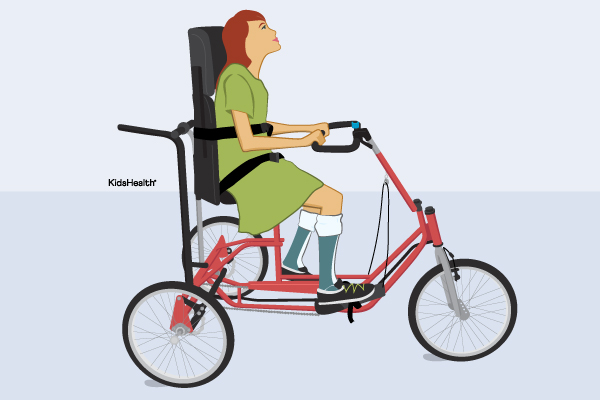
Adaptive Bicycle
What is it?
A supportive, 3-wheeled bicycle for kids with disabilities who are unable to ride a 2-wheeler independently.
What are the special features?
Body support and a wide wheel base.
Is it right for my child?
Kids with good head control, some torso control, and who can control most arm and leg movements may enjoy adaptive bikes. Also, kids with poor or fair head control who have an attendant who can steer and assist may benefit from adaptive bikes.
Is it covered by insurance?
Not usually, but your child may be eligible for funding through a social program.
- Caring for Your Teen With Cerebral Palsy (CP): Age 13 and Up
- Spina Bifida
- Spinal Muscular Atrophy (SMA): Steven's Story (Video)
- Words to Know (Special Health Care Needs Glossary)
- Caring for Your Child With Cerebral Palsy (CP): Age 6–12
- Caring for Your Child With Cerebral Palsy (CP): Birth to Age 5
- Cerebral Palsy (CP)
- Physical Therapy
- Assistive Devices: Positioning Aids (Slideshow)
- Occupational Therapy
 Note: All information is for educational purposes only. For specific medical advice,
diagnoses, and treatment, consult your doctor.
Note: All information is for educational purposes only. For specific medical advice,
diagnoses, and treatment, consult your doctor.
© 1995- The Nemours Foundation. KidsHealth® is a registered trademark of The Nemours Foundation. All rights reserved.
Images sourced by The Nemours Foundation and Getty Images.
Humana Healthy Horizons in Ohio
- Humana Healthy Horizons
- Humana Healthy Horizons Extras
- Member Support
- Care management
- Caregiver resources
- Child well-being
- Disease management
- Documents and forms
- Enrollment
- Grievances and appeals
- Health and wellness
- KidsHealth
- Member Handbook
- New Member Resources
- News and alerts
- OhioRISE Plan
- Pregnancy outcomes
- Tobacco cessation
- Why Humana
- Your primary care provider
- For Providers
- Contact us
- Accessibility
- Humana Healthy Horizons
- Humana Healthy Horizons Extras
- Member Support
- Care management
- Caregiver resources
- Child well-being
- Disease management
- Documents and forms
- Enrollment
- Grievances and appeals
- Health and wellness
- KidsHealth
- Member Handbook
- New Member Resources
- News and alerts
- OhioRISE Plan
- Pregnancy outcomes
- Tobacco cessation
- Why Humana
- Your primary care provider
- For Providers
- Contact us
- Accessibility