Athlete's Foot

What Is Athlete's Foot?
Athlete's foot is a type of fungal skin infection. Fungi (the plural of fungus) are microscopic organisms that thrive in damp, warm environments. They're usually not dangerous, but sometimes can cause disease. When they infect the skin, they cause mild but annoying rashes. Fungal skin infections are also known as tinea infections.
When fungus grows on the feet, it is called athlete's foot (or tinea pedis). It got this name because it affects people whose feet tend to be damp and sweaty, which is often the case with athletes. But anyone can get this infection.
Other fungal skin infections include jock itch and ringworm (despite its name, ringworm is not a worm).
These infections are caused by several types of mold-like fungi called dermatophytes (pronounced: der-MAH-tuh-fites) that live on the dead tissues of your skin, hair, and nails.
What Are the Signs & Symptoms of Athlete's Foot?
Athlete's foot usually causes redness, flakiness, peeling, or cracking of the skin on the feet. It may itch, sting, or burn, or simply feel uncomfortable.
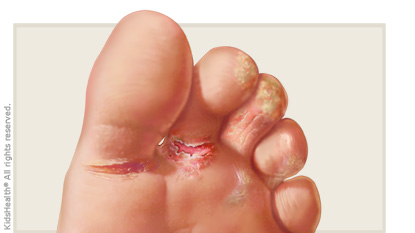
It's usually on the soles of the feet, the areas between the toes, and sometimes the toenails. When the toenails are involved they become thick, white or yellowish, and brittle.
What Causes Athlete's Foot?
Athlete's foot is caused by fungi that normally live on the skin, hair, and nails called dermatophytes. When the environment they live in gets warm and moist, they grow out of control and start to cause symptoms.
Is Athlete's Foot Contagious?
Yes. It spreads in damp environments, such as public showers or pool areas. It can also spread to other areas of the body if a person touches the affected foot and then touches other body parts, such as the hands.
How Do People Get Athlete's Foot?
Waking around barefoot in warm wet places like locker rooms or public pools can expose the feet to fungi that thrive in those environments. Sweaty shoes and socks add to the dampness and can make the infection worse. Sharing towels, sheets, clothing, or shoes with someone who has athlete's foot also can spread the infection.
How Is Athlete's Foot Diagnosed?
A doctor can often diagnose athlete's foot just by looking at it and asking questions about the symptoms and the person's lifestyle. Sometimes the doctor will scrape off a small sample of the flaky infected skin to look at under a microscope or to test in a laboratory.
How Is Athlete's Foot Treated?
Over-the-counter (OTC) antifungal creams, sprays, or powders may solve the problem if it is mild. More serious infections may need prescription medicine, either topical (applied to skin) or in pill form.
Whatever you use, continue treatment for as long as recommended, even if the rash seems to be getting better. If not, the infection can come back. Some people regularly use medicated foot powders and sprays to prevent athlete's foot.
How Long Does Athlete's Foot Last?
Most mild cases of athlete's foot clear up within 2 weeks. But treatment can go for several weeks or longer if the infection is more serious or affects the toenails.
Can Athlete's Foot Be Prevented?
Athlete's foot often can be prevented. To avoid it:
- Keep feet clean and dry by washing them daily and drying them completely, especially between the toes. (Use a clean towel.)
- Wear waterproof shoes or flip-flops when walking around in locker rooms, public showers, and public pool areas.
- Switch between wearing shoes or sneakers to prevent the build-up of moisture. Choose ones that are well-ventilated with small holes to keep the feet dry.
- Avoid socks that trap moisture or make the feet sweat. Instead, choose cotton or wool socks or ones made of fabric that wicks away moisture.
- Change socks regularly, especially if your feet get sweaty.
- Regularly wash socks, bedsheets, and towels.
- Don't share items like shoes, socks, and towels.
 Note: All information is for educational purposes only. For specific medical advice,
diagnoses, and treatment, consult your doctor.
Note: All information is for educational purposes only. For specific medical advice,
diagnoses, and treatment, consult your doctor.
© 1995- The Nemours Foundation. KidsHealth® is a registered trademark of The Nemours Foundation. All rights reserved.
Images sourced by The Nemours Foundation and Getty Images.